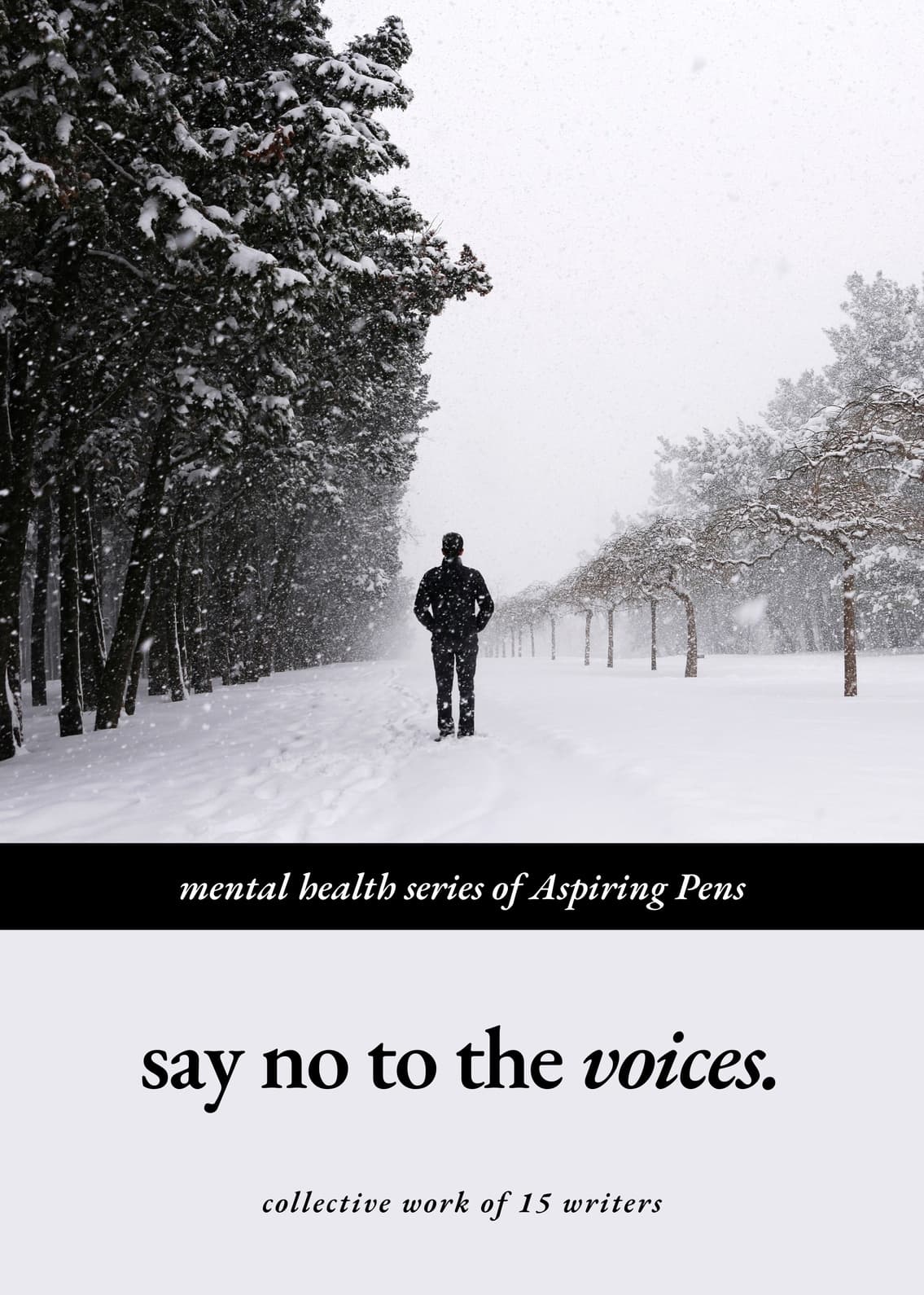
Say No to the Voices is a 2021 mental health anthology published by Aspiring Pens, gathering fifteen independent writers under a title that functions as both instruction and rallying cry; a collective refusal to let the voices that say you are not enough, you will never make it, you are alone go unchallenged. The book is defined by its subtitle: 'collective essays, passages and notes', and it honors that variety fully, the opening chapter is a gripping work of literary fiction following a woman with schizophrenia in a psychiatric hospital, haunted by hallucinations of the son she lost before birth, slowly learning to say no to the voice that destroys her; subsequent chapters shift into personal essays, confessional notes, philosophical passages, and prose poems that address depression and anxiety's specific lies, the physical and emotional experience of panic attacks, addiction and its social roots, colorism and body image, verbal violence within families, and the courage it takes to simply feel your emotions without apology. Several chapters are written with the directness of people who have lived what they describe; a writer narrates the onset of anxiety through a story of a girl losing her grandfather, then watching her mother battle cancer alone, written with an intimacy and specificity that only lived experience produces. A sustained, formally ambitious closing chapter uses the metaphor of an ocean: its surface chaos, its abyssal depth, the submarine cutting through current to explore how internal peace is built and protected from the noise of others' judgments. Throughout, the book insists on the same things in different voices and forms: that sensitivity is not weakness, that mistakes are not identities, that survivors of assault must be believed, that neglect is trauma, and that the most powerful act a person can take is to stop giving others' destructive words authority over their inner life. The title Say No to the Voices holds all of this together; it is not a passive suggestion but a daily, active, conscious refusal that each of these fifteen writers enacts on the page, and invites the reader to enact in their own life.